
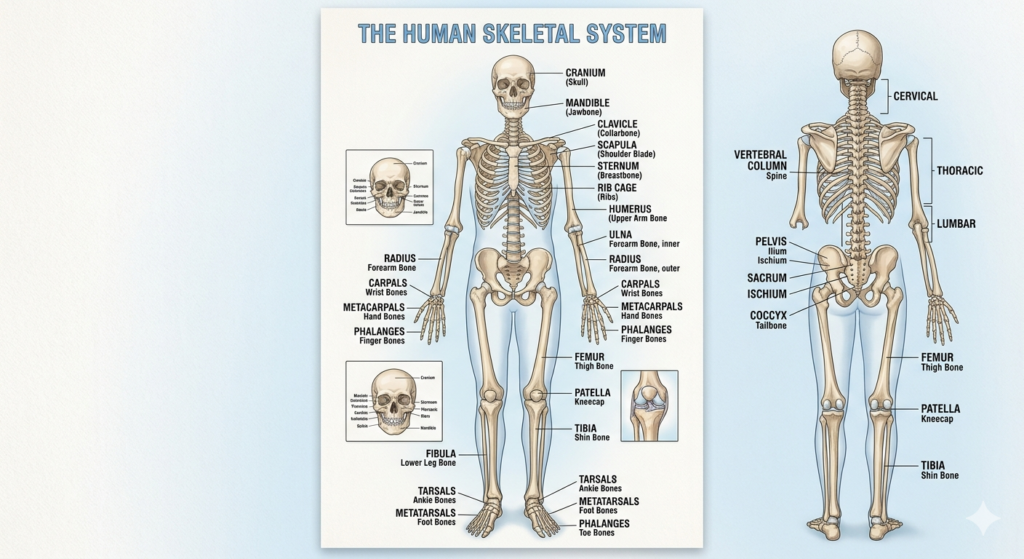
Human skeleton system
SKELETON SYSTEM :- INTRODUCTION OF SKELETON SYSTEM:– The skeletal system forms the framework of the body. It is the body system composed of bones, cartilage, and ligaments. Each bone serves a particular function and varies in size, shape, and strength.The skeleton consists of the bones of the body. For adults, there are 206 bones in the skeleton. Its providing support and movements of the body It protects the internal organs, including the brain, spinal cord, heart, lungs, and pelvic organs. The skeleton is subdivided into two major divisions: – 1.Axial Skeleton (80 bones):- Longitudinal axis of the body, including the skull, vertebral column, and thoracic cage (ribs/sternum). 2.Appendicular Skeleton (126 bones): Bones of the limbs and the girdles (pectoral and pelvic) BONES:- Bones are a vital component of the vertebrate skeletal system, providing structure and support to the body while also serving crucial roles in mobility, protection, and mineral storage. bones are essential for protecting critical internal organs. For example, the skull shields the brain,the ribcage safeguards the heart and lungs, and the vertebrae encase the spinal cord. Functions of the bone:- The function of bones included:- *providing the body framework *Giving attachments to muscles and tendons. *Allowing movement of the body as a whole and of parts of the body , by forming joints that are moved by muscles. *Haemopoiesis ,the production of blood cells in red bone marrow. * Mineral storage,especially calcium phosphate- the mineral reservoir within bone is essential for maintenance of blood calcium level, which must be tightly controlled. *Forming the boundaries of the cranial, thoracic and pelvic cavities,and protecting the organs. Types of Bones:- TYPES OF BONE SHAPES EXAMPLE FUNCTIION LONG LONG & CYLENDRICAL FEMUR MOVEMENT SHORT CUBE- LIKE CARPALS STABILITY FLAT THIN & FLAT SKULL PROTECTION IRREGULAR COMPLEX VERTEBRAE SUPPORT SESAMOID SMALL & ROUND PATELLA TENDON PROTECTION The skeleton is described in two parts:-1. AXIAL SKELETON 2. APPENDICULAR SKELETON 1. Axial skeleton:- The axial skeleton is the central core of the human body ,comprising 80 bones that protect vital organs and support upright posture. its consist of the skull,vertebral column ,sternum and ribs. * Skull (22 bones):- 8 cranial,14 facial bone. * Auditory Ossicles (6 bones): Three tiny bones in each middle ear (malleus, incus, stapes) Hyoid Bone (1 bone): U-shaped neck bone that supports the tongue and larynx. Vertebral Column (26 bones): 7 cervical, 12 thoracic, 5 lumbar vertebrae, 1 sacrum, and 1 coccyx (tailbone). Thoracic cage(25 bones):- 24 ribs(12 pairs) and sternum (breastbone) Skull :- The skull acts as a rigid, protective helmet for the brain while providing structural support for the face, sensory organs, and muscle attachments.The skull is described in two parts ,cranium, which contain brain and face. its consist of several bones,which develop separately but fuse togather as they mature. included 22 bones, 8 cranial bone and 14 facial bone.Cranial bone :- Frontal bone (1) Parietal bones (2) Temporal bones (2) Occipital bone (1) Sphenoid bone (1) Ethmoid bone(1) 2. facial bone:- Nasal bones (2) Maxillae (2) Zygomatic bones (2) Palatine bones (2) Lacrimal bones (2) Inferior nasal conchae (2) Vomer (1) Mandible (1) :-function of skull:– The various parts of the skull have specific and different functions:- *The primary function is protecting the brain, cranial nerves, and meninges from injury.