

INTRODUCTIONOF CULTURE MEDIA
Most bacteria can be cultured artificially on culture media containing required nutrients, pH and osmotic pressure. The microorganisms grow in an atmosphere and temperature most suited to their metabolic reactions. The pathogens are isolated in pure culture so that they can be identified and tested for their sensitivity to antimicrobials. The specimens are cultured in known volumes, and the number of bacterial colonies appearing after incubation can be counted. Operation room requirements and blood from blood bank are frequently checked for sterility by using pure culture methods. Vaccines and antitoxins require the growing of bacteria under controlled conditions. Stock cultures are also useful for the teaching institutes for practical training purposes.
COMPOSITION OF CULTURE MEDIA
The basic ingredients, which are common to the many of the frequently used media are as follows:
1. Water: It allows fluids to enter and leave cells more readily and to enhance the chemical reactions.
2.Sodium chloride: Presence of sodium chloride maintains the isotonicity of bacterial cells.
3.Peptones: It is a source of readily available nitrogen.
4.Buffers: They maintain a constant pH in culture media.
5.Indicators: In culture media the indicators are useful in the detection of acid or alkali production by microorganisms. Indicators such as phenol red, methyl red and Bromocresol purple are used to adjust pH of the culture media.
6. Solidifying
agents: Agar, gelatin, egg yolks and serum are used as
solidifying agents of the culture media.
7.Selective
agents: These are special chemicals introduced into the culture media for inhibiting some types of bacteria, while allowing other bacteria to grow. Examples: (a) Crystal violet inhibits Staphylococci but not tubercle bacilli (b) 6.5% (w/ v) sodium chloride is inhibitory to most
Streptococci but not S. faecalis.
8. Additive for enrichment: The substances such as sheep blood, horse blood, rabbit serum or calf’s ground hearts allow fastidious organisms to grow since these organisms, may not survive in ordinary culture media.
9.Reducing substances: The substances such as thioglycollate are used to remove free oxygen from the medium for the growth of anaerobic bacteria.
THE DIFFERENT TYPES OF CULTURE MEDIA
Basic Media
These support the growth of microorganisms that do not have special nutritional requirements. They are often used (a) To maintain stock cultures of control strains of bacteria and (b) For subculturing pathogens from selective media prior to performing biochemical and serological dentification tests. Examples: (1) Nutrient agar (2) Nutrient broth.
Enriched Media
These are enriched with (a) Whole blood (b) Lysed blood (c) Serum (d) Extra peptones and (e) Vitamins to support the growth of
particular pathogens such as Hemophilus influenzae, Neisseria and Streptococcus
species. Examples: (I) Blood agar (II) Tryptone soya media.
Selective Media
These media contain substances that accelerate the growth of required pathogens only and prevent or slow down the growth of other microorganisms.
Example:
XLD agar: It is used for the growth of Salmonellae and Shigellae. The bile
salts present in this media inhibit the growth of many fecal commensals
Differential (Indicator) Media
These contain indicators, dyes or other substances
which help to differentiate microorganisms. Example: TCBS agar contains the
indicator bromothymol blue which differentiates sucrose fermenting from non-sucrose
fermenting vibrio species.
Transport Media
When specimens are not cultured soon after collection,
to prevent overgrowth and also to ensure survival of pathogens, transport media
are used. These are mainly used to transport microbiological specimens from
health centers to the district pathological laboratories. Example: (1) Amies
transport medium (2) Cary Blair medium.
DIFFERENT FORMS OF CULTURE MEDIA:-
1. Solid Culture Media
This is used in petri dishes and in test tubes (slope cultures) and prepared by adding Solidifying agent (1.0 – 1.5%) (w/v). Microorganisms grow on this and form colonies after multiplication. This helps to identify the organism.
2. Semisolid Culture Media
This is prepared by adding Solidifying agent (0.4-0.5%) (w/v) to a fluid medium. These
are used mainly as transport media and for the testing of motility of the organisms.
3. Fluid Culture Media
These media
are mainly used as biochemical testing media, blood culture media or the
enrichment media.
PREPARATION OF CULTURE MEDIA
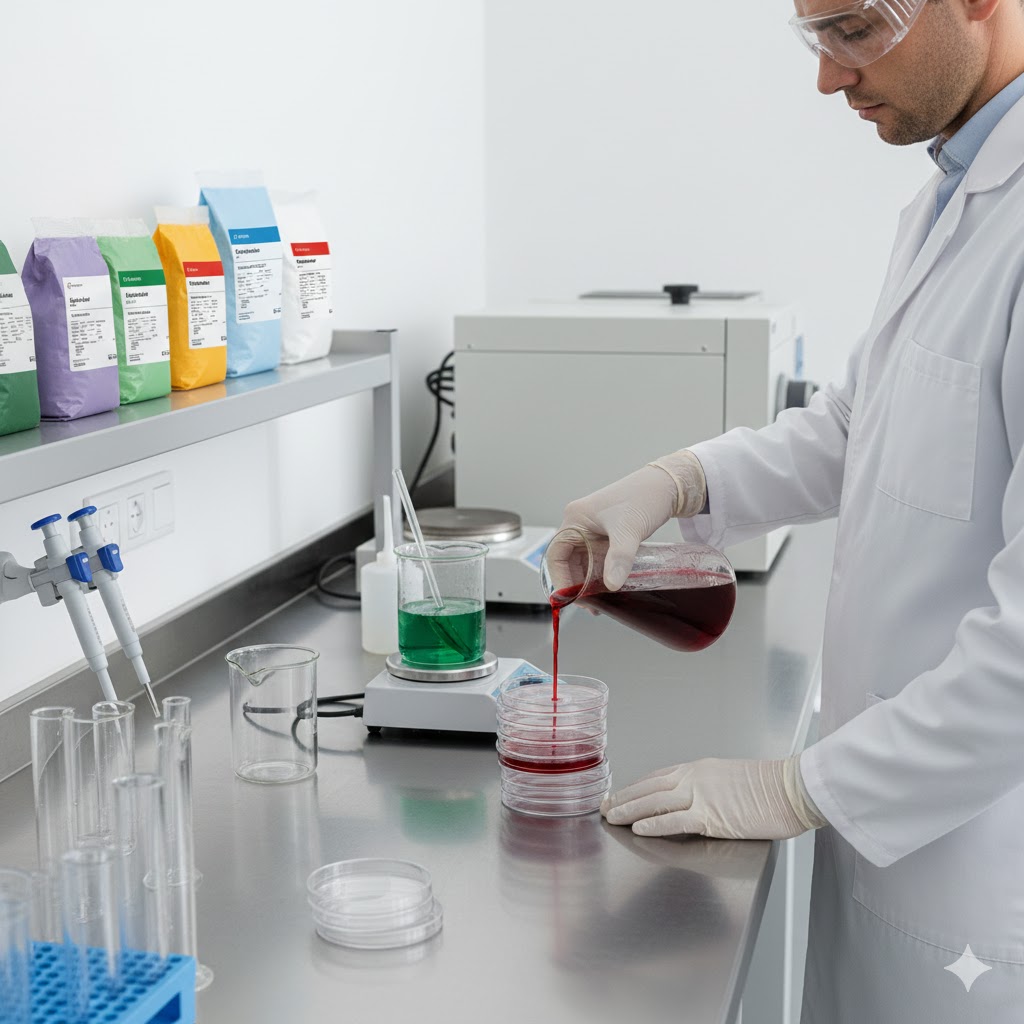
Most culture media are available commercially in readymade dehydrated form. It is less costly to use readymade media, since the ingredients are often required in small amounts but available in large quantities if purchased. Some of the chemicals are also difficult to obtain.
To ensure good performance and reproducibility in the results the following must be performed correctly-
1. Weighing and dissolving of the
ingredients
2. Addition of heat sensitive material
3. pH testing
4. Dispensing and sterilization
5. Sterility testing and quality
control
6. Storage
Note
1. The heat sensitive ingredients such as blood or serum should be brought to room temperature and added when the medium has cooled to about 50°C.
2. A fluid medium should be tested for accurate pH by using a narrow, range pH paper.
3. For sterilizing culture media, it is necessary to use manufacturer’s instructions. The commonly used methods for sterilization are- a) Autoclaving (b) Steaming at 100°C and (c) Filtration. It is necessary to use correct temperature and correct length of time.
Precautions:-
1. Autoclaving is used to sterilize most agar and fluid media.
2. Steaming at 100°C: Media such as Cary Blair transport medium contain ingredients that would break down above 100°C. Steaming can be performed in an autoclave with a loose lid.
3. Filtration: Serum and solutions containing carbohydrates, urea, etc. are heat sensitive and hence cannot be autoclaved. Hence, the media containing such substances are filtered to remove bacteria.
4. Sterility testing: Media in tubes and bottles: Incubate the entire batch at 37°C overnight. Contamination is indicated by appearance of turbidity in a fluid medium and growth on a solid medium.
5. Control of media: Appropriate control species are used to inoculate slants or plates of the medium (quarter part). After overnight incubation, the cultures are examined for (a) Degree of growth (b) Size of colonies and (c) Other characteristics.
6.Storage of culture media: Dehydrated culture media and dry ingredients (agars, peptones, bile salts, etc.) can be stored at room temperature (25°C ± 5°C) in a cool and dry place, away from direct light. Additives such as blood, serum, urea and carbohydrates in solution form are stored at 2-8°C in the refrigerator.
Basic
Method of Preparation of Culture Medium – Step by Step
1. Weigh the solid ingredients by using an analytical balance.
2. Add sufficient quantity of distilled water.
3. Dissolve the ingredients by using a glass rod or by using a magnetic stirrer. If necessary, heat the solution to dissolve the ingredients. Cool the solution to room temperature.
4. Adjust required pH by using 1N sodium hydroxide or 1N hydrochloric acid and a narrow range pH paper.
5. When agar is required, it is added afterwards and the solution is heated again to introduce agar in the solution.
6. When indicator is required, it is added by cooling the solution to about 40°C.
7. Final volume is made by using distilled water.
8. The prepared medium is distributed while hot, in the conical flasks, bottles and test tubes.
9. The medium in the various containers is sterilized by autoclaving at 121°C for 15 minutes.
10. The containers are stored at 2-8°C. Shelf life of most of the media is several weeks provided there is no change in the appearance of the medium to suggest contamination or degradation.
PREPARATION
OF CULTURE PLATES
Introduction
A culture plate of standard size (10 cm diameter)
contains 20 to 25 ml of sterile culture media. The use of petri dishes is
convenient for aerobic culture of an organism. The petri dishes allow the
organism to be isolated in pure colonies from the commensals.
Procedure
1. Sterilize the medium by autoclaving in a conical flask.
2. Cool the culture medium to about 55°C.
3. Under aseptic conditions, pour the melted culture medium (15 to 20 ml) into sterilized petri dishes.
4. Allow the medium to solidify in a flat position.
5. Keep the petri dishes in the inverted position overnight at room temperature (25°C ± 5°C).
6. Store the petri dishes in the inverted position in a refrigerator at 2-8°C.
Notes
1. Placing of the petri dishes in inverted position during incubation and storage prevents condensation of moisture on the lid (the plates are then clear for viewing).
2. A plate is useless for streaking when the condensed water from the lid falls on the agar surface.