Biochemistry

Biochemistry explores the chemical and molecular basis of life. It includes topics like metabolism, enzymes, proteins, carbohydrates, lipids, and nucleic acids. This subject forms the core of understanding disease mechanisms and drug actions in healthcare.

Biochemistry, Uncategorized

SERUM DIRECT AND INDIRECT BILIRUBIN

SERUM DIRECT BILIRUBIN:-   Aim: – Determination of Serum Direct Bilirubin by DMSO method & Malloy and Evelyn method Summary:- Bilirubin is a breakdown product of hemoglobin, insoluble in water. It is transported from the spleen to the liver and excreted into bile. Hyperbilirubinemia results from the increase of bilirubin concentrations in plasma. PRINCIPLE:-   Bilirubin is converted to colored azobilirubin by diazotized sulfanilic acid and measured photometrically. Of the two fractions presents in serum, bilirubin-glucuromide and free bilirubin loosely bound to albumin, only the former reacts directly in aqueous solution (bilirubin direct), while free bilirubin requires solubilization with dimethylsulphoxide (DMSO) to react (bilirubin indirect). In the determination of indirect bilirubin, the direct is also determined; the results correspond to total bilirubin. The intensity of the color formed is proportional to the bilirubin concentration in the sample.  REQUIREMENTS:-   *Two test-tube, *Colorimeter, Bilirubin *Direct Reagents,  *Incubator, *Cuvette, *Pipette etc. *Fresh Serum. PROCEDURE-   1.      Adjust the instrument to zero with distilled water. 2.   Pipette into a cuvette or test tube: Contents Blank Test Direct Bilirubin Reagent (R2) 1.5 ml 1.5 ml Working Reagent (R3) – 50µl Sample /Calibrator 50µl 50µl 1.      Mix and incubate for exactly 5 minutes at room temperature.        2.      Read the absorbance (A). at 546 nm wavelength. Calculation:-  With Factor: Direct Bilirubin (mg/dl) =              (A) Sample – (A) Sample Blank x Factor Theoretical Factor Direct bilirubin = 14 Direct Bilirubin (mg/dl)  =             (A) Sample – (A) Sample Blank x 14 After Testing, If, (A) Sample = 0.21 (A)   Sample Blank = 0.16                                                                  =             0.05 X 14                                                                  =             0.7 mg/dl    D. Bilirubin in mg/dl to µmol/L   =             mg/dL x 17.1 =          0.7 X 17.1 =          11.97 µmol/L Normal Value:-    Direct Bilirubin (mg/dl)           =         <0.3 mg/dl Clinical Significance:-  Causes of hyperbilirubinemia:- Direct bilirubin: Hepatic cholestasis, genetic errors, hepatocellular damage. Indirect bilirubin:- Indirect Bilirubin (mg/dl)              =             Total Bilirubin – Direct Bilirubin =             1.146 – 0.7 =             0.446 mg/dl Or                      =             0.446 X 17.1 µmol/L =             7.62 µmol/L Normal Value:-    Indirect Bilirubin (mg/dl)        =         0.3  – 0.9 mg/dl

Biochemistry

VLDL AND LDL Cholesterol Test

Indirect method:- Fairly accurate determination of VLDL & LDL can be done for the values of cholesterol less than 400 mg/dl, by using the following formulae based on “The Friedewald equation”. Determine-    a) Total cholesterol    b) HDL- cholesterol and    c) T.G. Then calculate VLDL and LDL as follows: VLDL (mg/dl)                      =          Triglyceride/5 LDL-cholesterol (mg/dl)    =          Total Cholesterol – HDL – VLDL  Normal Value:- VLDL                =          2 – 38 mg/dl  LDL                  =          < 130 mg/dl Clinical Significance:- This test measures the amount of very low-density lipoprotein (VLDL) in your blood. VLDL cholesterol is a type of blood fat. It’s considered one of the “bad” forms of cholesterol, along with LDL cholesterol and triglycerides. This is because high levels cholesterol can clog your arteries and lead to a heart attack. High levels of LDL (low-density lipoprotein) cholesterol are associated with an increased risk of atherosclerosis, which can lead to other health conditions like stroke, coronary artery disease, and peripheral arterial disease

Biochemistry

GLOBULINE AND A/G RATIO

Globulin & AG Ratio Aim:-   Find out of globulin protein and AG Ratio from Total protein and Albumin. Method: – Calculation Globulin (g/dl) = Total Protein – Albumin If, Total Protein is = 6.46 g/dl, &  Serum Albumin is = 4.30 Then,  Globulin (g/dl) = 6.46 – 4.30 Globulin (g/dl) = 2.16  AG Ratio Calculation:- AG Ratio = Albumin / Globulin  AG Ratio = 4.30/2.16 AG Ratio = 1.99  Normal Value:- AG Ratio = 0.9 – 2.0 g/dl  Globulin = 2.5 – 3.5 g/dl

Lipase Test
Biochemistry

LIPASE

Methyl Resorufin Method: INTENDED USE: The reagent kit is intended for the in vitro quantitative determination of lipase in serum/plasma. PRINCIPLE: In the presence of colipase and bile acids, lipase splits the synthetic substrate (1,2-O-dilauryl-rac-glycero-3-glutaric acid 6-methylresorufin ester) to form lauric acid and methylresorufin. The rate of hydrolysis is measured photometrically and is proportional to the catalytic activity of lipase present in the sample. CONTENTS: Reagent 1: Lipase Reagent R1 Reagent 2: Lipase Reagent R2 Reagent 3: Lipase Calibrator SAMPLE: Serum or plasma with sodium citrate, EDTA, or heparin. PRECAUTION: To avoid contamination, use clean laboratory materials, use clear reagents and glassware. Avoid direct exposure of reagents to light. PROCEDURE: Pipette into clean dry test tubes labeled as Blank (B), Calibrator (C), and Test (T): Component Blank (B) Calibrator (C) Test (T) Reagent 1 1.0 ml 1.0 ml 1.0 ml Calibrator — 20 µl — Sample — — 20 µl Mix carefully (do not vortex). Incubate for 1–5 min at 37°C and read absorbance at 580 nm.Add Reagent 2: 250 µl to each tube, mix gently and read absorbance after exactly 120 sec (A2). CALCULATION: For kinetic:Lipase U/L = (ΔOD/min Sample / ΔOD/min Blank) × Calibrator Concentration For fixed time:Lipase U/L = (Abs (A2–A1) Sample / Abs (A2–A1) Calibrator) × Calibrator Concentration NORMAL RANGE: Up to 60 U/L(Each laboratory should establish its own normal range.) CLINICAL SIGNIFICANCE: Lipase is a pancreatic enzyme necessary for the absorption and digestion of nutrients. The deficiency of lipase or disorders of fat digestion may result in the abnormal digestion of fats and malabsorption. Clinical diagnosis necessitates the presence of pancreatic duct obstruction, acute pancreatitis, and other conditions. GENERAL SYSTEM PARAMETERS: Reaction type: Kinetic Reaction slope: Increasing Wavelength: 580 nm Cuvette: 1 cm Reaction temperature: 37°C Dead time: 60 sec No. of readings: 3 Sample volume: 20 µl Calibrator: 2 points Working reagent volume: 1.25 ml (1000 + 250) Blank: Reagent Assay procedure: 1 cm light path LINEARITY: Up to 300 U/L. If activity is greater than 300 U/L, dilute the sample with normal saline and repeat the assay. Multiply result by dilution factor.

Sodium
Biochemistry

SODIUM (MONO TEST)

Sodium Reagent Kit (Mono Test) INTENDED USE: This reagent kit is intended for the in vitro quantitative determination of sodium in serum. PRINCIPLE: The reagent is based on reaction of sodium with a selective chromophore producing a chromogenic complex whose absorbance is directly proportional to sodium concentration in the sample. CONTENTS: Reagent 1: Sodium Reagent Reagent 2: Sodium Standard (150 mEq/L) SAMPLE COLLECTION AND PRESERVATION: Serum or heparinized plasma. Sodium is stable for 2 weeks at 2–8°C. REAGENT PREPARATION AND STORAGE: All reagents are ready to use. Store reagents at room temperature (2–30°C).  PROCEDURE:- Pipette into clean dry test tubes labeled as Blank (B), Standard (S), and Test (T): Component Blank (B) Standard (S) Test (T) Sodium reagent 1.0 ml 1.0 ml 1.0 ml Standard — 10 µl — Sample — — 10 µl Mix well and incubate at RT for 5 minutes.Measure the absorbance of Standard (Abs S) and Test (Abs T) against reagent blank at 630 nm. CALCULATION: Concentration of Sodium (mEq/L) = (Abs T / Abs S) × 150 NORMAL VALUES: Serum/Plasma: 135 – 155 mEq/L It is recommended that each laboratory establish its own normal range depending on patient population. QUALITY CONTROL: It is recommended that controls be included in each set of assays. GENERAL SYSTEM PARAMETERS: Reaction type: End point Wavelength: 630 nm Cuvette: 1 cm Reaction temperature: Room temperature Reagent volume: 1.0 ml Sample volume: 10 µl Incubation time: 5 minutes Blank absorbance limit: ≤ 1.2 Standard: 150 mEq/L NOTE:-   As sodium is a very widely distributed ion, care should be taken to avoid any contamination. All glassware being used for the test should first be rinsed with 150 mEq/L sodium-free water.

Biochemistry

CREATININE SINGLE REAGENT

CREATININE(Modified Jaffe’s Liquid Reagent):- INTENDED USE The reagent kit is intended for the in-vitro quantitative determination of creatinine in serum and urine. SUMMARY Creatinine is excreted as a waste product by the kidneys. Increased serum creatinine levels usually indicate impairment of renal function. It is commonly measured to evaluate kidney function and muscle metabolism. PRINCIPLE Creatinine in alkaline medium reacts with picric acid to form an orange coloured complex.The intensity of colour formed is directly proportional to the amount of creatinine present in the sample. REAGENTS Creatinine Reagent Creatinine Standard: 2 mg/dL MATERIALS REQUIRED BUT NOT PROVIDED Clean dry glassware Micropipettes & tips Laboratory timer Colorimeter / Spectrophotometer PREPARATION OF REAGENT & STABILITY The reagent kit is stable at 2–8°C till expiry date. Once opened, store reagent properly. PROCEDURE Tube Reagent Sample Standard Blank 1.0 ml – – Standard 1.0 ml – 100 µl Test 1.0 ml 100 µl – Mix well and record absorbance of test (AT) and standard (AS) at 510 nm. CALCULATION For Serum Creatinine (mg/dL) = ATAS×2 For Urine Creatinine (mg/dL) = ATAS×2×50frac{AT}{AS} times 2 times 50   NORMAL VALUES Serum: Male 0.6 – 1.5 mg/dL, Female 0.4 – 1.4 mg/dL Urine: Male 15 – 20 mg/kg/day, Female 8 – 15 mg/kg/day PRECAUTIONS Do not freeze reagents Bring reagents to room temperature before use Use clean and dry glassware Follow standard laboratory safety precautions

Biochemistry

CHOLESTROL

Cholestrol(CHOD / POD METHOD) INTENDED USE This reagent is intended for the in-vitro quantitative determination of cholesterol in human serum. PRINCIPLE Cholesterol esters are hydrolyzed by cholesterol esterase to free cholesterol and fatty acids.Free cholesterol is oxidized by cholesterol oxidase to cholestenone and hydrogen peroxide.Hydrogen peroxide reacts with 4-aminoantipyrine and phenol in presence of peroxidase to form a red coloured quinoneimine dye. REACTION Cholesterol Ester + H₂O → Cholesterol + Fatty acidsCholesterol + O₂ → Cholestenone + H₂O₂H₂O₂ + Phenol + 4-aminoantipyrine → Red quinoneimine REAGENTS Cholesterol Enzyme Reagent Cholesterol Standard (200 mg/dL) SPECIMEN :- Serum / Plasma PROCEDURE Tube Reagent Sample Standard Blank 1.0 ml – – Standard 1.0 ml – 10 µl Test 1.0 ml 10 µl – Mix well, incubate at 37°C for 5 minutes.Read absorbance at 505 nm against reagent blank. CALCULATION Cholesterol (mg/dL) = Abs(Test)Abs(Standard)×200frac{Abs(Test)}{Abs(Standard)} times 200 Abs(Standard)Abs(Test)×200 NORMAL VALUE Total Cholesterol: Less than 200 mg/dL CLINICAL SIGNIFICANCE Cholesterol is the main lipid found in blood. It is an essential structural component of cell membranes and is involved in the synthesis of steroid hormones and bile acids. Elevated cholesterol levels are associated with atherosclerosis and increased risk of coronary heart disease. STORAGE   Store reagent at 2–8°C. Do not freeze.

Biochemistry

Amylase kit

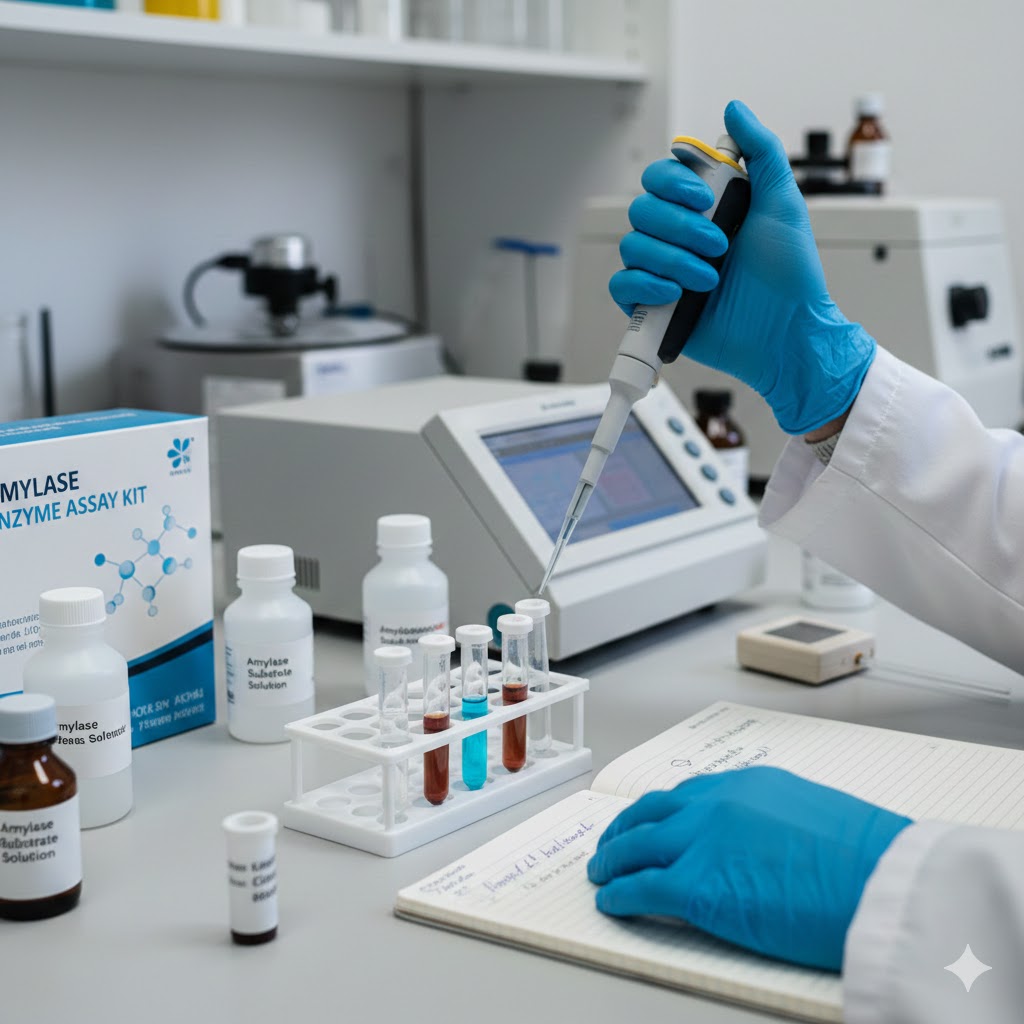
Amylase Kit(Direct Substrate Method):- INTENDED USE:- This diagnostic reagent kit is intended for in-vitro quantitative determination of amylase activity in human serum or plasma. PRINCIPLE Amylase catalyzes the hydrolysis of a 2-chloro-4-nitrophenyl linked substrate. The rate of hydrolysis is proportional to amylase activity in the sample. REACTION CNPG₃ + Amylase → CNP + G₃ + G₄ CONTENT Reagent-1 / Amylase Reagent MATERIALS REQUIRED BUT NOT PROVIDED Clean & dry glassware Laboratory glass pipettes / micropipettes & tips Bio-Chemistry Analyzer SAMPLES Serum free from hemolysis, heparinized plasma, or EDTA plasma. Specimen should be tested as fresh as possible. PROCEDURE Pipette into clean labeled test tubes: Component Blank Sample Working Reagent 1000 µl 1000 µl Sample — 20 µl Mix well and read the absorbance after 1, 2 & 3 minutes.Calculate the mean absorbance per minute (ΔA/min). CALCULATION OF RESULTS Amylase Activity (U/L) = ΔA/min × 3178 NORMAL VALUE Serum Amylase: Up to 100 U/L at 37°C CLINICAL SIGNIFICANCE Amylase is secreted by the pancreas into the duodenum. It catalyzes the hydrolysis of starch into sugars. Measurement of amylase activity is useful in the diagnosis of pancreatic disorders such as acute pancreatitis, pancreatic cancer, and pancreatic duct obstruction. GENERAL SYSTEM PARAMETERS Reaction Type Kinetic Wavelength 405 nm Temperature 37°C Delay 60 sec Incubation 60 sec Reaction 60 sec Sample Vol. 20 µl Reagent Vol. 1000 µl LIMITATIONS AND PRECAUTIONS Use non-hemolyzed samples Avoid contamination Do not use turbid or lipemic samples Do not freeze reagents QUALITY CONTROL Run normal and pathological controls with each assay.

SGPT (ALT) Test
Biochemistry

SGPT

SGPT INTENDED USE:This reagent kit is intended for in-vitro quantitative determination of SGPT (ALT) activity in serum. PRINCIPLE:SGPT (ALT) catalyzes the transfer of amino group between L-alanine and α-ketoglutarate to form pyruvate and glutamate. The pyruvate formed reacts with NADH in the presence of Lactate Dehydrogenase (LDH) to form lactate and NAD. The rate of oxidation of NADH to NAD is measured as a decrease in absorbance which is proportional to the SGPT (ALT) activity in the sample. REACTION:Alanine aminotransferaseL-Alanine + α-Ketoglutarate → Pyruvate + L-Glutamate Lactate DehydrogenasePyruvate + NADH + H⁺ → Lactate + NAD⁺ CONTENTS:Reagent 1: SGPT Enzyme ReagentReagent 2: SGPT Substrate Reagent MATERIALS REQUIRED BUT NOT PROVIDED:• Clean & Dry Glassware• Micropipettes & Tips• Bio-Chemistry Analyzer SAMPLES:Serum free of hemolysis. SGPT (ALT) is reported to be stable in serum for 3 days at 2–8°C. PROCEDURE:Pipette into clean dry test tubes as (T): Addition sequence Blank Test Working Reagent 1000 µl 1000 µl Sample — 100 µl Mix well and read the initial absorbance after 1 min and repeat the absorbance reading after every 1 min. Calculate the mean absorbance change per minute (ΔA/min). CALCULATION:SGPT activity (U/L) = ΔA/min × 1746

Potassium
Biochemistry

POTASSIUM

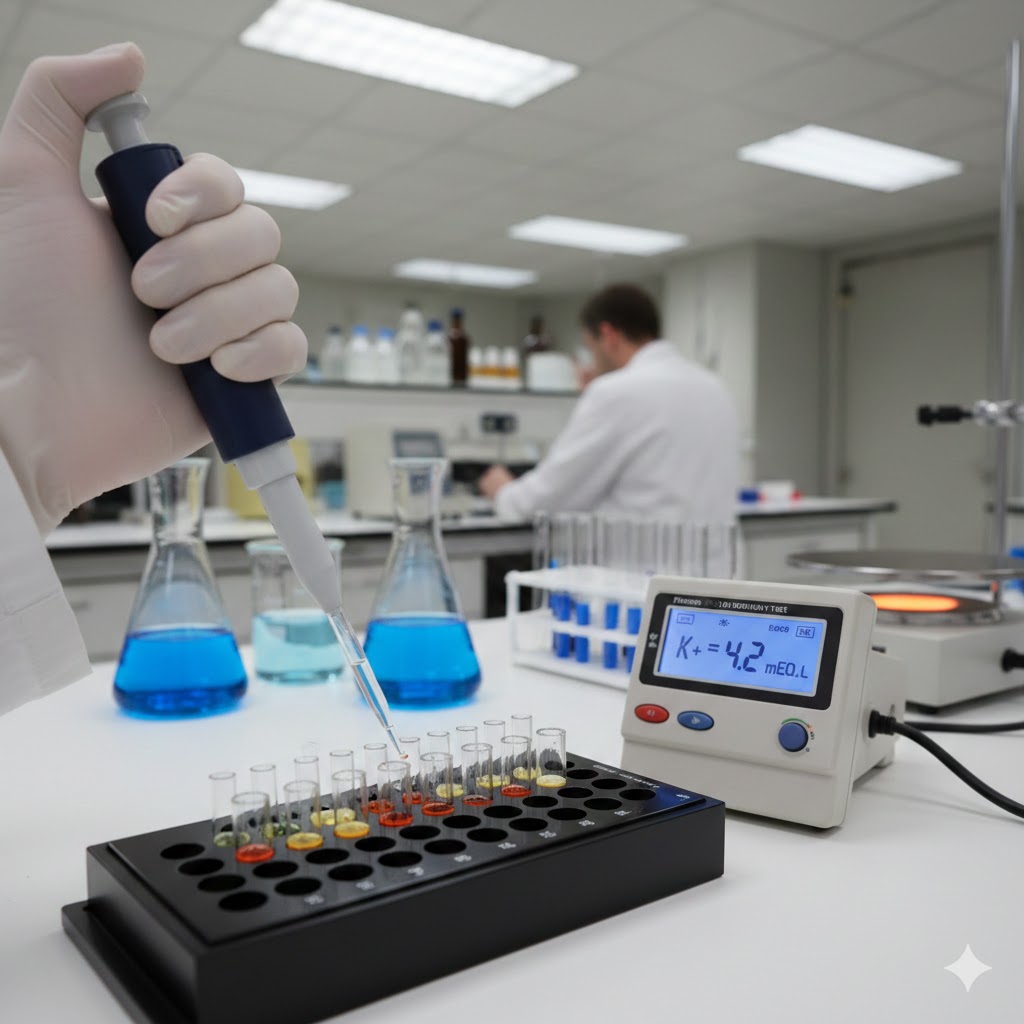
POTASSIUM (Monotest) BEACON INTENDED USE: This reagent kit is intended for the in-vitro quantitative determination of Potassium in Serum. PRINCIPLE: Potassium reacts with sodium tetraphenyl boron in a specially prepared buffer to form a colloidal suspension. The amount of turbidity produced is directly proportional to the concentration of potassium in the sample. CONTENTS: Reagent 1: Potassium Reagent Reagent 2: Potassium Standard 5 mEq/L SAMPLE COLLECTION AND PRESERVATION: Separate serum from the clot as soon as possible as potassium may leach from red blood cells which can elevate results. REAGENT PREPARATION AND STORAGE: All reagents are ready to use. Temperature: 25–30°C. PROCEDURE: Pipette into cuvettes labeled as Blank (B), Standard (S), and Test (T). Addition Sequence B S T Potassium Reagent 1.0 ml 1.0 ml 1.0 ml Standard — 20 µl — Sample — — 20 µl Mix well and incubate at RT for 5 mins. Measure the absorbance of Standard and Test against reagent blank at 630 nm. CALCULATION: Concentration of Potassium (mEq/L) = (Abs. T / Abs. S) × 5 NORMAL VALUES: 3.5 – 5.5 mEq/L Each laboratory should establish its own normal range. GENERAL SYSTEM PARAMETERS: Reaction type: End point Wavelength: 630 nm Cuvette: 1 cm Reaction temperature: Room temperature Zero setting: Reagent blank Sample volume: 10 µl Reagent volume: 1.0 ml Incubation time: 5 mins Standard concentration: 5 mEq/L REAGENT SYSTEM STABILITY: Reagents are stable until the expiration date mentioned on the label. LINEARITY: The procedure is linear up to 7 mEq/L.If values exceed this limit, dilute the sample with distilled water and multiply results with dilution factor. NOTES: As potassium is widely distributed, care should be taken to avoid contamination. All glassware should be free from alkali to avoid falsely high values. BIBLIOGRAPHY: Tietz NW, Fundamentals of Clinical Chemistry, W.B. Saunders Co., Philadelphia Henry RF et al., Clinical Chemistry Principles and Techniques David A. Sacks et al., Tietz Textbook of Clinical Chemistry Trinder, P., Ann. Clin. Biochem., 1969 (6: 159) QUALITY CONTROL: It is recommended that controls be included in each set of assays.

Scroll to Top