
SUMMARY:
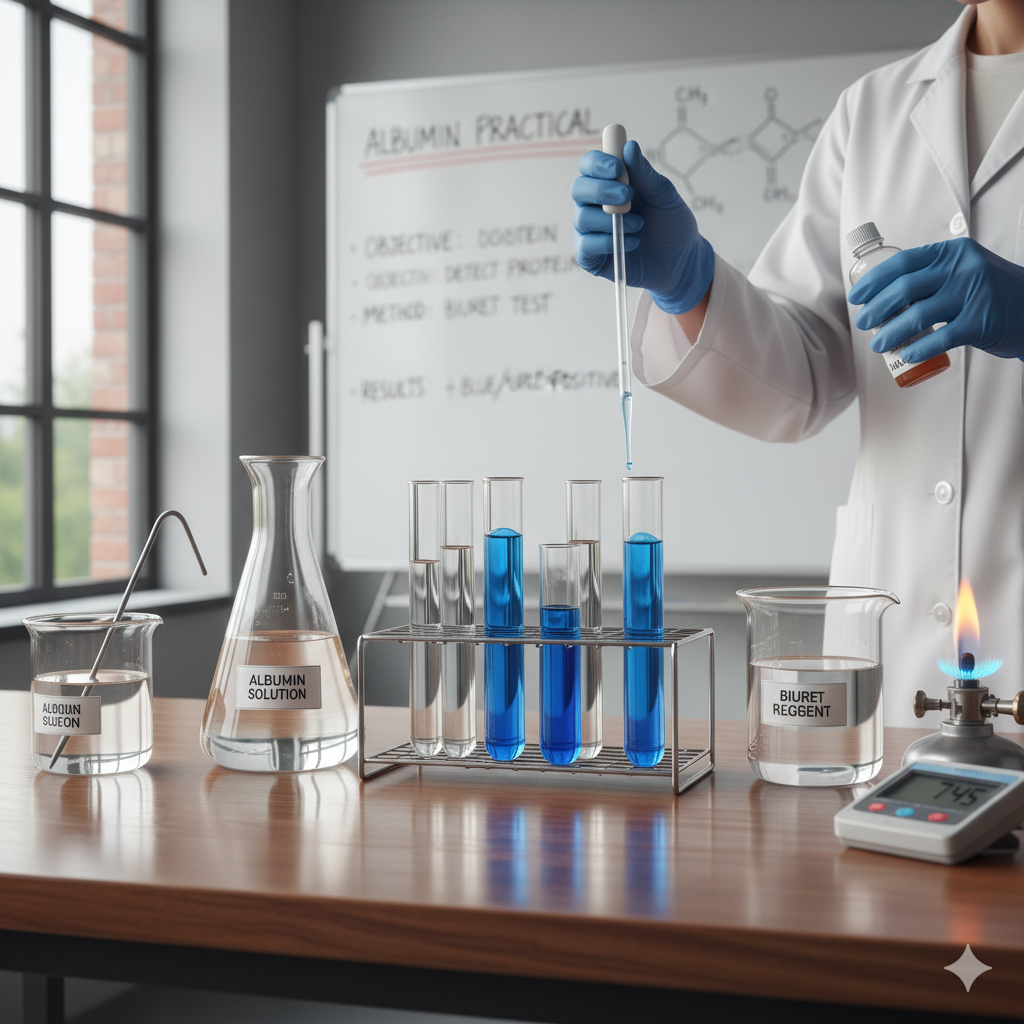
Albumin a major plasma protein is synthesized in the liver from amino acids, which are absorbed from the liver. Its function includes regulation of distribution of extracellular fluid, transportation of various hormones, steroids, and amino acids.
Aim:
Estimation of Serum Albumin by BCG (Bromocresol Green) method.
PRINCIPLE:
Albumin binds with bromocresol green at pH 4.2 causing a shift in absorbance maximum of the Yellow BCG dye. The resulting bluish-green color is measured photometrically. The intensity of the color is directly proportional to the albumin concentration. The absorbance of the test and standard are measured against blank at 630 nm wavelength.
Albumin + BCG → Albumin-BCG complex (blue-green color)
REQUIREMENTS:
Three test tubes
Colorimeter with Automatic Pipetter
Total Protein working reagent
Distilled water
Cuvette
Pipette
Serum Sample
PROCEDURE:
| Contents | Blank (ml) | Standard (ml) | Test (ml) |
|---|---|---|---|
| Working reagent | 1.0 | 1.0 | 1.0 |
| Distilled water | 1.0 | – | – |
| Standard | – | 0.1 | – |
| Serum | – | – | 0.1 |
For further help WhatsApp us: +91-9891068072
INSTRUCTIONS:
Measure all content according to the chart in the test tubes.
Mix well and incubate for 5 minutes at 37°C temperature in incubator.
Read the optical density of the test and standard at 630 nm wavelength.
Calculation:
Serum Albumin (g/dL)
= (Optical Density of Test × Concentration of Standard) / (Optical Density of Standard)
Example Calculation:
After testing:
Optical Density of Test = 0.318
Optical Density of Standard = 0.24
Therefore:
= (0.318 × 4.0) / 0.24
= 5.3 g/dL
Normal Values:
| Parameter | Normal Range |
|---|---|
| Total Protein | 6.0 – 8.0 g/dL |
| Albumin | 3.5 – 5.0 g/dL |
| Globulin | 2.5 – 3.5 g/dL |
| A/G Ratio | 1.0 – 2.0 |
Clinical Significance:
Increased levels of albumin are present in cases of dehydration, especially noted for newborns.
Decreased levels of albumin are present in conditions like malnutrition, nephrotic syndrome, hepatic