
Amylase Kit(Direct Substrate Method):-
INTENDED USE:-
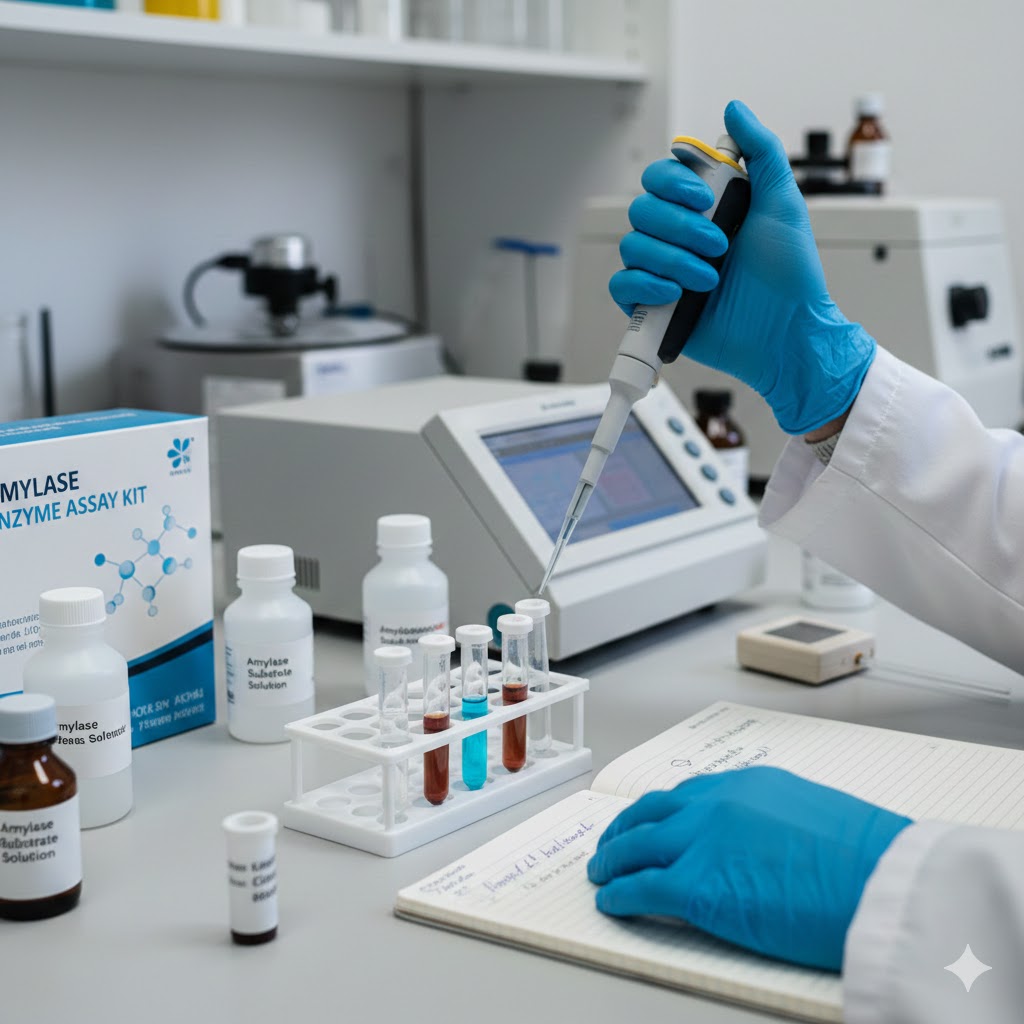
This diagnostic reagent kit is intended for in-vitro quantitative determination of amylase activity in human serum or plasma.
PRINCIPLE
Amylase catalyzes the hydrolysis of a 2-chloro-4-nitrophenyl linked substrate. The rate of hydrolysis is proportional to amylase activity in the sample.
REACTION
CNPG₃ + Amylase → CNP + G₃ + G₄
CONTENT
Reagent-1 / Amylase Reagent
MATERIALS REQUIRED BUT NOT PROVIDED
Clean & dry glassware
Laboratory glass pipettes / micropipettes & tips
Bio-Chemistry Analyzer
SAMPLES
Serum free from hemolysis, heparinized plasma, or EDTA plasma.
Specimen should be tested as fresh as possible.
PROCEDURE
Pipette into clean labeled test tubes:
| Component | Blank | Sample |
|---|---|---|
| Working Reagent | 1000 µl | 1000 µl |
| Sample | — | 20 µl |
Mix well and read the absorbance after 1, 2 & 3 minutes.
Calculate the mean absorbance per minute (ΔA/min).
CALCULATION OF RESULTS
Amylase Activity (U/L) = ΔA/min × 3178
NORMAL VALUE
Serum Amylase: Up to 100 U/L at 37°C
CLINICAL SIGNIFICANCE
Amylase is secreted by the pancreas into the duodenum. It catalyzes the hydrolysis of starch into sugars. Measurement of amylase activity is useful in the diagnosis of pancreatic disorders such as acute pancreatitis, pancreatic cancer, and pancreatic duct obstruction.
GENERAL SYSTEM PARAMETERS
| Reaction Type | Kinetic |
|---|---|
| Wavelength | 405 nm |
| Temperature | 37°C |
| Delay | 60 sec |
| Incubation | 60 sec |
| Reaction | 60 sec |
| Sample Vol. | 20 µl |
| Reagent Vol. | 1000 µl |
LIMITATIONS AND PRECAUTIONS
Use non-hemolyzed samples
Avoid contamination
Do not use turbid or lipemic samples
Do not freeze reagents