





Blood banking index:-
1. Blood Bank Management & Documentation of Packaging:-
Reception, Indexing & Recording
Decontamination of blood bags, workbench, andal and immune antibodies) Distribution of ABO antigens (A, B, and H Antigens) on red cells and antibodies in the serum.
Rh blood group system
Sources of errors in ABO grouping
instruments
Sterilization of transfusion sets (physical & Chemical)
2. Discovery of Human Blood Group:-
Theory of inheritance and nomenclature of ABO and Rh blood group system
Subgroup of ABO system and Bombay group.
3. Technique for Determination of Various Blood Groups and Rh factors:-
Determination of various blood groups (NaturABO hemolytic disease
4. Cross Matching and Complications of Blood Transfusion
Cross math
Immunological complications, non-immunological complications.
History of blood bank:-
The history of Blood Bank began in 1616 when William Harvey Discovered that blood circulation through the body.
In 1665, a transfusion of blood from lamp saved a young patient’s life. This led to- animal to human transfusion becoming common.
The first blood bank was established in a Leningrad hospital in 1932.
IN 1937, Bernard Fantus was the director of the therapeutics at cook county hospital in Chicago. Established the first hospital blood bank in the United States.
Fantus created a hospital laboratory that preserved refrigerated and stored donor blood.
He also coined the term “blood bank”. The first blood bank in India was established in Kolkata in March 1942.
The red cross managed the blood bank at all India institute of Hygiene and public health.
The first successful transfusion of human blood to a patient was performed in 1818 by British obstetrician James Blundell. Blundell’s transfusion was to treat postpartum hemorrhage.
In 1901, three main blood groups were discovered in 1902, the blood group is discovered in 1907.
Cross matching was first used in 1914; the first non-directed transfusion was performed.
- In 1917, the first blood depot was established
-: Universal safety rules for blood bank technicians: -
Working in blood bank is a noble profession that’s required almost care and precautions.
Blood bank technicians play a crucial role in ensuring the safety of both donors and recipients. To maintain a lifesaving legacy, it is essential for these technicians to follow universal safety rules.
Personal protective equipment (PPE): –
Always wearing appropriate PPE including
Gloves
Lab Coat / Gown / Apron
Face Protection
Head Cover / Cap
Shoe Covers / Closed Shoes
Additional PPE (when needed)
Safety goggles
When handling blood and blood products.
1.Hand hygiene: –
Hand hygiene is one of the most critical infection control practices in blood bank, since staff handle human blood, component, and samples that may carry infectious agents like HIV, HCV.
Wash your hands frequently and thoroughly with soap and water, apply 3-5 ml of sanitizer, rub for 20-30 second until dry should contain 60-95% alcohol.
2. Sharp object safety: –
Prefer safety engineered needles and syringes with retractable or shielded tips.
Do not recap needles after use.
Avoid passing sharps directly from hand to hand (use trays).
Dispose of used needles, scalpels, and glass pieces immediately after use in puncture-proof, leak-proof, clearly labelled sharps containers.
Keep the blood collection area clean, uncluttered, and well-lit.
Handle glass blood bottles, vacutainers, and pipettes carefully to prevent breakage.
Regular staff training on safe handling, disposal, and emergency procedures.
Posters and reminders in the blood bank to reinforce best practices.
3.Infection control:-
Follow standard precaution to prevent the spread of infectious disease treat all blood product are potentially infectious.
4. Labelling: –
Ensure proper labelling of all blood products and specimens confirm the information and levels match the requisition forms.
5..Blood typing and cross match: –Double check patients’identification and blood compatibility before transfusion to prevent error.
Blood typing is the process of determining a person’s blood group based on the presence or absence of specific antigens on red blood cells (RBCs).
Crossmatching is done before a blood transfusion to ensure compatibility between donor and recipient blood. It prevents haemolytic transfusion reactions.
6. Blood donation: –
blood donation is the voluntary process of giving blood, which is then used for transfusions or to make blood components (like plasma, platelets, or red blood cells) for patients in need. If involved in the collection process, ensure that all blood donation equipment sterile and used according to established procedures
7. Equipment maintenance: –
Regularly inspect and maintained equipment like refrigerator, freezer, and centrifuge to ensure the integrity of blood products
8.Storage:-
Follow strict instructions of guidelines for storing blood products ensure proper temperature control and monitor for any signs of spoilage or contamination.
9.Emergency procedures: –
Stay calm and follow the laboratory’s Standard Operating Procedures (SOPs)
Protect yourself first using PPE (gloves, mask, apron)
Alert staff and supervisor immediately
Document the incident properly
10.Disposal: –
Dispose of biohazardous waste including contaminants materials and sharps, accordance with rule -regulation and guidelines.
11.Training and education: –
Stay current with blood banking procedures and safety practices throughout the regular training and continuing education.
12.Quality control:-
Participate in quality control and assurance programs to maintain the highest standards of safety and accuracy.
13.Documantaion: –
Maintain accurate records of all blood product handling testing and transfusions.
Document any incidents or deviations from standards procedures
14. confidentially: –
Maintain strict confidently of patient information and blood donor records.
15.Communication: –
Clearly and accurately communicate with healthcare providers and other staff involved in the blood transfusion process.
16.Safety data sheets (SDS): –
Familiarize yourself with safety data sheets for all chemicals and reagents used in the blood bank follow safety instructions and guidelines.
17. zero tolerance for risky behaviour: –
Report any unsafe practices or deviations from safety protocols to your supervisor immediately
18.contnuous monitoring: –
Regularly monitor and assess safety practices to identify and address potential risks and improvement.
Donor selection:-
Pre-donation counselling by trained staff should be made available maintaining privacy and confidentiality pre donation information should be included.
Modes of transmission leading to risk behaviour and self-exclusion for patients’ safety.
Alternative testing site
Test carried out on donated blood.
Confidentiality of test results.
Need for honest answer in view of window period.
Criteria for selection of blood donors: –
Following guidelines should be observed to determine that the blood donation will not be detrimental to the donors /recipients.
1.Physical examination: –
A medical officer should certify that the donor fit for the blood donation.
General appearance: –
Age: – Donor should be 18–65 years, Older than 65 may donate with medical clearance
Weight: –Blood collection from donors waging 45-55kg, 45 kg should be 350 ml blood and 55 kg should be 450 ml.
Haemoglobin or packed cell volume: –
The haemoglobin should be not less than 12.5 mg/dl in both male and female or packed cell volume should be not less than 36%.
Blood pressure: –
The systolic blood pressure should be between 90 -150mmHg of mercury and the diastolic pressure should be between 70-100mmHg of mercury.
Temperature: –
Temperature should not be exceeded 37.50C/99.50F.
Pulse: – 60–100 beats per minute.
General Health: –
Must be in good health and feel well on the day of donation
No chronic or acute illnesses
No recent infections
Medical history: –
Conditions that affect safety of donors: –
Before each donation question should be asked to determine that the donor is in normal health and has not suffered from any serious illness.eg
Malignant disease, epilepsy, branchial asthma, diabetes, excessive menstrual bleeding, cardio-vascular conditions, renal disease, allergic -disease, abnormal bleeding tendency.
Pregnancy: –
Prospective donor should not be accepted during period of pregnancy and till 12 months.
After full term delivery and during lactation female don’t donate blood.
After abortion 6 months don’t donate blood.
Surgical procedure: –
Donors should be accepted one year after recovery from major operation and 6 months. After recovery from minor operation including acupunctures tot toing and scarification.
Donation interval: –
The interval between two blood donations should be at least 3 months.
Viral infections: –
HIV, HCV, HbsAg, malaria syphilis etc. positive patient can’t donate blood.
Human Blood group system: –
There are nearly 300 blood group systems so for discovered. The ABO and Rh are major, the most important of all the blood group system. All people (with some exception) of ABO system can be divided in 4 major groups in this system they are A, B, AB and O group. This determines by the reaction of two different reagent, known Anti A, and Anti B.
For example: – Forword grouping or cell grouping by using known Anti A and Anti B results obtained are as follow.
Red cell sample | Reagent | Reaction | Blood group |
Red cell | Anti A | Agglutination |
A group |
Red cell | Anti B | No agglutination | |
Red cell | Anti A | No agglutination |
B group |
Red cell | Anti B | Agglutination | |
Red cell | Anti A | Agglutination | AB group |
Red cell | Anti B | Agglutination | |
Red cell | Anti A | No agglutination |
O group |
Red cell | Anti B | No agglutination |
PRACTICAL OF ABO AND Rh TYPING: –
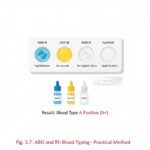
ABO and Rh typing performed by two methods
Slide method
Test tube method
Aim: –
ABO grouping and Rh typing using the slide method.
Objective: –
ABO grouping and Rh typing using the slide method, which is a standard procedure for determining an individual’s ABO and Rh blood types.
Principle: –
ABO grouping and Rh typing performed by antisera based on the principle of agglutination.
Normal human red cell processing antigen will clump in the presence of corresponding antibody (Anti A, Anti B, Anti D)
Requirement: –
* whole blood sample (EDTA)
* Disposable gloves
* Clean glass slide
* ABO grouping and Rh typing reagents
* Toothpicks or wooden sticks
* Droppers of pipettes
* Absorbent paper towels
* Timer or stopwatch
* Blood typing record sheet.
Preparation: –
Ensure that you are working in a well-lit and clean laboratory environment
Label each glass slide with the patient’s identification or sample number
Put on disposable gloves to maintain aseptic conditions
ABO blood grouping procedure:-
* Take three clean and dry glass slides
* Place one drop of patient’s blood on each slide
* Add a drop of Anti A reagent on first slide anti B on second slide, Anti D on third slide.
* Mix the blood and serum gently using separate wooden sticks
Observation and record the reaction: –
* if blood agglutinates (clumps)with anti A serum then the patient blood group is A.
*.If blood agglutinates with anti B serum, then the patient blood group is B.
*.If blood agglutinates with anti A and anti B both serums, then the blood group is AB.
*.If blood do not agglutinate with both anti A and anti B serum, then the blood group is O.
Antisera A | Antisera B | Blood group |
+ | – | A |
– | + | B |
+ | + | AB |
– | – | O |
Rh blood grouping procedure: –
Take clean and dry glass slide
Place a fresh drop of the patient blood on slide
Add a drop of anti Rh (anti D) serum.
Mix gently with wooden stick.
Observation and record the reactions: –
*.if the blood agglutinates with anti Rh serum, then the patient blood Rh positive e.g. (A+, B+, AB+, O+)
*.If blood is not agglutinate with anti Rh serum, then the patient blood Rh negative e.g. (A-, B-, AB-, O-)
Antisera D | Blood group |
+ | Rh positive |
– | Rh negative |
Clinical significance: –
ABO grouping and Rh typing is important in: –
Blood transfusion
Used for the personal identification and paternity exclusion (before DNA testing)
Before a person donates blood.
Before an organ and tissue transplant
Before surgery
To show whether to people could be blood relatives
To check the identity of a person suspected of committing a crime.
Note:-
The ABO and Rh typing determination is used for the transfusion safety, pregnancy management, transplantation, forensic identification, and understanding disease susceptibility.
-: Test tube method: –
AIM: –ABO grouping and Rh typing by test tube method.
Principle: –
In the ABO grouping and Rh typing using the antisera is based on the principle of agglutination.
Normal human red cell processing antigen will clump in the presence of corresponding antibody.
Requirements: –
*.blood group tube
*.Pasteur pipettes.
*.Centrifuge.
*.Reagent.
*.Normal saline.
*.Blood sample.
Procedure: –
Prepare 5% red cell suspension for ABO grouping and Rh typing.
Mix 5 drops(0.05ml) of sediment red cell with 2 ml of normal saline.
*.Centrifuge at 1500 rpm for 1–2-minute discard the supernatant part wash 3 time with normal saline.
*.Add 4ml of normal saline to sedimented red blood cells.
*.Take 3 test tube label them as A, B, D.
*.Place 1 drop of anti A into ‘A’ tube, one drop of anti B into the ‘B’ tube. one drop of anti D in ‘D’ tube.
*.Add one drop of RBC suspension to each tube.
*.Gently shake each tube to mix the contents. And then centrifuge tube at 1500 rpm for 1 minute.
*.The RBC will form a button or pellet at the bottom of each test tube.
*.Gently resuspend the RBC button and examine agglutination macro and microscopically.
Observation: –
Antisera A | Antisera B | Blood group | |
+ | – | A | |
– | + | B | |
+ | + | AB | |
– | – | O |
Antisera D | Blood group |
+ | Rh positive |
– | Rh negative |
Subgroup of ABO system and Bombay blood group: –
The ABO blood group is determined by the presence of A and B antigen on red cells or antigens with subgroup like A1 and A2 differing in antigen quality which are controlled by ABO gene.
The ABO system has subgroup that are variants of the main A, B, AB types, primarily differing in the quantity or structure of the antigen.
A1 and A2 subgroup:-
The most common A subgroup is A1 and A2 which have different amount of the A antigen on their red blood cells.
A1(80%) subgroup is a strong expression of A antigen. agglutinate with Anti A and Anti A.
A2 (20%) Weaker expression of A antigen. React with Anti A but not with Anti A1 lectin.
Sometime A2 individuals produce anti-A1 antibody (causing discrepancies in grouping).
Normal ABO antigen (A&B) is built upon the H antigen (formed by H gene).
BOMBAY BLOOD GROUP (hh or Oh phenotype):-
The Bombay blood group, also known as the hh or Oh phenotype, is a rare blood group.
Bhende. Required a blood transfusion but showed agglutination(clotting)with every known blood type.
Dr. Y.M Bhende and his team at the Seth Govrdhan das Sunder Das Medical College struggled to find compatible donor for the patient.
After extensive searching, they find a result that whose blood matched both patients.
It appears like blood group O but is different because it lacks the H antigen on the surface of red blood cells.
This unique blood group which did not existing in ABO system,
Then named the Bombay Blood group or hh group after the city of its discovery.
Normal ABO system: –
*.Blood group A → has A antigen (made from H antigen)
*.Blood group B → has B antigen (made from H antigen)
*.Blood group O → has only H antigen
Bombay group: –
*.Has no A, no B, and no H antigen on red blood cells.
*.The serum contains anti-A, anti-B, and anti-H antibodies.
Blood Grouping Characteristics:-
Test | Reaction | Explanation |
Forword grouping (cell test) | No agglutination with anti A or anti B | No A or B antigen |
Reverse grouping (serum test) | Agglutination with A, B. and O cells | Presence of anti- A, anti -B and anti- H antibodies |
Transfusion Significance:-
*.Bombay group individuals cannot receive blood from any other group, not even group O, because group O blood has H antigen.
*.They can only receive blood from another Bombay blood group donor.
*.It’s extremely rare about 1 in 10,000 people in India. About 1 in million people worldwide.
Clinical importance: –
Transfusion reactions may occur if Bombay group is mistaken for group O.
Special testing (using Anti-H lectin from Ulex europaeus) is needed for correct identification.
Important in blood bank screening and family genetic studies.

Reverse blood grouping /serum grouping: –
Reverse blood grouping is a procedure to confirm ABO blood group based on the presence or absence of anti A and anti B in serum using known A and B red cells.
It is a cross check for Forword typing performing both Forword and reverse grouping provides a check for accuracy.
Because if the lack of synthesized immunoglobulin anti A and anti B in newborn and very young infants.
This procedure is not performed on infants below 4 months of age.
Principle: –
The serum of a person contains antibodies against the ABO antigens that are absent on their red blood cells.
When the serum is mixed with known reagent red cells (A cells and B cells), agglutination occurs if the corresponding antibody is present.
Requirement: –
Specimen: –
Serum is specimen for reverse blood grouping no special preparation of the patient is required prior collection.
The specimen should be tested as soon as possible after collection, but specimen may be stored at 2-8 ° c.
If there is a delay in testing storage may result in weaker than normal reaction.
Cell suspension: –
Although red cell reagents for serum grouping are available commercially most laboratories prepare their own A and B test red cell from person known to be group A and group B.
Procedure: –
The reverse blood grouping can be performed in two methods. Tube and slide method. The tube method is preferred to slide method.
Reverse grouping by tube method:-
1.Label two test tube as A and B.
2.Add two drops of serum to be tested in each tube.
3.Add one drop of A and B cell suspension to each corresponding tube.
4.Mix well and centrifuge both tube at 1000 rpm for 1 minutes.
5.Gently remove the tubes and completely resuspend cells and examine macroscopically agglutination and if negative, them microscopically.
6.Record the reaction and interpret the results.
Reverse grouping by Slide method: –
1.Mark a clean slide into two halves, labelling the left and right side as A and B.
2.Add a drop of serum to be tested on both sides.
3.Add one drop each of A and B cell suspension (20%) to corresponding sides.
4.Use a clean applicator stick, mix the serum and cell suspension on both sides separately and spread into a smooth round circle.
5.Rock the slide gently for two minutes and look for agglutination.
6.Record the reactions and interpret the result.
-:Result and interpretation:-
If agglutination is observed with A cells only, then the patient blood group B.
If agglutination is observed with B cells only, the patient blood group A.
If agglutination is observed with both A and B cells, then the blood group is O.
If agglutination is not observed with both A and B cells, then the blood group is AB.
–: Blood transfusion: –
Blood transfusion is a medical procedure in which blood or blood components are transferred from a donor into the circulation of a recipient through a vein. It’s done to replace lost blood, improve oxygen -carrying capacity, or correct certain blood disorders.
The basic principle observed for blood transfusion are: –
*.The blood donation must be harmless to the donor.
*.The blood donated must not be harmful to the patient (recipient)in fact, must be beneficial to the patient.
Some criteria accepted for selection of the donor: –
Age- above 18 year (18-60).
*.Hemoglobin should not be less than 12.5 g/dl
*.Interval between donation should be minimum 16 weeks or 3 months.
*.Pulse rate should be regular and between 70-100/min.
*Accepted blood pressure systolic: between 90-150mm Hg
Diastolic: between 50-100mmHg.
*.Temperature of the donor should be normal and there should be absence of any chronic disease.
The donor is rejected in the case of the following: –
If there is history of viral hepatitis or AIDS.
*.If there is history of malaria within last 3years.
*.Recent vaccination or medication.
*.After surgery or dental extraction.
*.Pregnancy or menstruation.
*.If the patient has received immunization against rabies mumps, smallpox, rubella etc. within 6 months.
*.Major operation within 1 year or minor operation within 6 months.
*.If the donor has undergone dental surgery.
Questions regarding the following points are asked to protect donor: –
Time span since last blood donation.
*Medication or vaccination.
*History of certain clinical condition such as heart disease, respiratory disease, renal disease, gastrointestinal disorders, bleeding disorders, diabetes mellitus fainting and convulsions.
*Menstruation
*Pregnancy
Questions regarding the following points are asked to donor for protection of recipient: –
History of hepatitis.
History of malaria
History of self-injected drugs.
Transfusion of blood or blood component within 6 months.
Recent immunization or vaccination.
History of malignancy.
Alcohol within 72 hours.