
INTRODUCTION:-
The gradual development of immunohistochemical methodologies over the pastdecades has allowed the identification of specific or highly selective cellularepitopes in formalin-fixed paraffin-embedded tissues with an antibody and appropriate labeling system
IMMUNOHISTOCHEMISTRY :-
Immunohistochemistry is a technique for identifying cellular or tissue constituents (antigens) by means of antigen-antibody interactions, the site of binding can be identified by direct labeling of the antibody or by use of a secondary labeling
method.
Antigen-Antibody binding :-
The amino acid side-chains of the variable domain of an antibody form a cavity which is complementary to a single type of antigen like a lock and key. The precise fit required explains the high degree of specificity seen in antigen antibody interaction.
Affinity:- is the 3 dimensional fit of the antibody to its specific antigen and is a measure of the binding strength between antigen and antibody.
Avidity: is the functional combined strength of an antibody with its antigen. An antibody against more than one epitope of an antigen will bind more strongly to it.
Antibody specificity: is the characteristic of an antibody to bind selectively to a single epitope or an antigen.
Sensitivity: is the relative amount of an antigen that a technique is able to detect.
Primary reagents :-
Polyclonal antibodies: they are produced by immunizing an animal with a purified specific molecule (immunogen) bearing the antigen of interest. The animal will mount a humoral response to the immunogen and the antibodies so produced can be harvested from animal blood. The serum is polyclonal in nature as it comprises of a mixture of antibodies to different epitopes present on the antigen. Some of these antibodies may cross react with other molecules and produce nonspecific staining.
Monoclonal antibodies:- Hybridoma method is used to produce these antibodies and it combines the ability of a plasma cells or transformed B lymphocytes to produce a specific antibody with the in vitro immortality of a neoplastic myeloma cell line. With the technique of cloning, this cell can be grown and multiplied in cell culture to unlimited numbers and can produce large supply of particular antibodies.
Labels:- Enzymes are the most widely used labels in IHC, and incubation with a chromogen using a standard histochemical method produces a stable, colored reaction end-product suitable for the light microscope. Horseradish peroxidase is the most widely used enzyme, and in combination with the most favored chromogen, i.e. 3,3’- diaminobenzidine tetrahydrochloride (DAB) it gives a crisp, insoluble, stable, dark brown reaction end-product.
Immunohistochemical Methods:-
Methods
There are numerous IHC staining techniques that may be used, the selection should be based on parameters such as type of specimen, type of preparation (frozen or paraffin section) and sensitivity required.
Traditional Direct technique: the primary antibody is conjugated directly to the label. The conjugate may be either a fluorochrome or enzyme. The labeled antibody reacts directly with the antigen. The technique is quick and easy to use but provides little signal amplification and is less sensitive, so its used to demonstrate immunoglobulins and complements in frozen sections of skin and renal biopsies.
New direct technique (Enhanced polymer one step staining method):
available under the commercial name of EPOS. A large number of primary antibodies and peroxidase enzymes are attached to a dextran polymer ‘backbone’, hence increasing the signal amplification.
Two step indirect technique: A labeled secondary antibody directed against the immunoglobulin of the animal species in which the primary antibody has been raised visualizes an unlabeled primary antibody. It is more sensitive than direct
technique.
Antigen retrieval :-
The demonstration of many antigens can be significantly improved by thepretreatment with the antigen retrieval reagents that break the protein cross-linksformed by formalin fixation and thereby uncover hidden antigenic sites. It canbe done by enzymatic method and/or heat induced. The most popular enzymes employed today are trypsin and protease. The enzymatic digestion breaks down formalin cross-linking and hence the antigenic sites are uncovered.
Heat based antigen retrieval methods have brought great improvement in IHC. The theories suggested for the role of heat pretreatment include: heavy salts act as protein precipitant forming insoluble complexes with polypeptides. Another theory is that heat mediated retrieval removes the weaker Schiff bases formed during formalin fixation.
The different methods of heat based antigen retrieval include
1. Microwave antigen retrieval
2. Pressure cooker antigen retrieval
3. Steamer
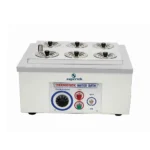
4. Water bath
Microwave antigen retrieval with a non toxic citrate buffer at pH 6.0 has demonstrated results equivalent to frozen sections. Most domestic microwave ovens are suitable for antigen retrieval . Uneven heating and the production of hot-spots have been reported, but using 400-600 ml of buffer in a suitably sized container can minimize these problems.
Pressure cooker has been suggested as an alternative to microwave oven. Batch variation and production of hot and cold spots in microwave can be overcome. Pressure cooker is said to be more uniform in heating. Also the increased temperature (120°C) attained under pressure is an advantage in unmasking antigens.
Buffers used for antigen retrieval:
*Sodium Citrate Buffer (10mM Sodium Citrate, 0.05% Tween 20, pH 6.0)
*Tri-sodium citrate (dihydrate) 2.94 g
*Distilled water 1000 ml
*Mix to dissolve. Adjust pH to 6.0 with 1N HCl.
*Add 0.5 ml of Tween 20 and mix well. Store at room temperature for 3
months or at 4°C for longer storage.
*1 mM EDTA, adjusted to pH 8.0
*EDTA 0.37 g
*Distilled water 1000 ml
*Store at room temperature for 3 months
*Tris-EDTA Buffer (10mM Tris Base, 1mM EDTA Solution, 0.05% Tween
*20, pH 9.0)
*Tris 1.21 g
*EDTA 0.37 g
*Distilled water 1000 ml (100 ml to make 10x, 50 ml to make 20x)
*Mix to dissolve. pH is usually at 9.0.
*Add 0.5 ml of Tween 20 and mix well. Store at room temperature for 3
months or at 4°C for longer storage
IHC staining
All incubations should be carried out in a humidified chamber to avoid drying of the tissue. Drying at any stage will lead to non-specific binding and ultimately high background staining. A shallow, plastic box with a sealed lid and wet tissue paper in the bottom is an adequate chamber, just as long as the slides are kept off the paper and can lay flat so that the reagents don’t drain off. A good solution is to cut a plastic serological pipette into lengths to fit your incubation chamber. Glue them in pairs to the bottom of the chamber, with the 2 individual pipette tubes of each pair being placed about 4.0 cm apart. This provides a level and raised surface for the slides to rest on away from the wet tissue paper.
Dilutions of the primary and secondary antibody are listed on the datasheets or are determined by testing a range. Adjust dilutions appropriately from the results obtained. Adhere strictly to all incubation times in the protocol.For enzymatic methods, horseradish peroxidase (HRP) or alkaline phosphatase (AP) are the most commonly used enzymes. There are a number of chromogens
used with these enzymes.
Day 1
1. If using an HRP conjugate for detection, incubate the slides in 0.3% H2O2
in Tris Buffered Saline (TBS) for 15 min
2. Wash the slides 2 x 5 minutes in TBS plus 0.025% Triton X-100 with gentle
agitation.
3. Block in 10% normal serum with 1% BSA in TBS for 2 hours at room
temperature.
4. Drain slides for a few seconds (do not rinse) and wipe around the sections with tissue paper
5. Apply primary antibody diluted in TBS with 1% BSA
6. Incubate overnight at 4°C
Day 2
1. Rinse 2 x 5min TBS 0.025% Triton with gentle agitation.
2. For enzymatic detection (HRP or AP secondary conjugates): Apply enzyme
conjugated secondary antibody to the slide diluted to the concentration
recommended by the manufacturer in TBS with 1% BSA, and incubate for
1 hour at room temperature.
3. Rinse 3 x 5min TBS.
4. Develop with chromogen for 10 min at room temperature
6. Rinse in running tap water for 5 min.
7. Counterstain (if required)
8. Dehydrate, clear and mount with DPX