
INTRODUCTION:-
The technique of getting fixed tissues into paraffin is called tissue processing.
This describes the steps required to take animal and human tissues from fixation
to the state where it is completely infiltrated with a suitable wax i.e. paraffin wax
and can be embedded and ready for section cutting on microtome
OBJECTIVES:-
After reading this lesson, you will be able to:
*define tissue processing
*describe its aim and method of processing.
Aim: To process the fixed tissue into a form in which it can be made into thin
microscopic sections.
Processing: The steps in this process are dehydration and clearing.
Dehydration: It is the process of removing water from tissues. It is important
because paraffin is not miscible with water. Dehydration is usually complete
when less then 3-4% of water remains in the tissues. Time required for this
depends on:
1. Permeability of tissues
2. Continuous rotation of fluid to prevent stagnation of fluid around tissues
3. Temperature
4. Vacuum applied
Dehydrants: Ethyl alcohol, Methyl alcohol, Butyl alcohol and Isopropyl
alcohol.
The most commonly used dehydrant is ethyl alcohol.
Alcohol Method:-
The tissues are passed through a series of progressively more concentrated alcohol baths. Concentration of first alcohol bath depends on the fixative and size and type of the tissue, e.g. delicate tissue needs lower concentration of alcohol and smaller interval between two strengths of alcohol.
Usually 70% alcohol is employed as the first solution and100% as the last solution. After about 40 tissues have passed through the first change of alcohol, it is discarded and all the other changes are brought one step lower. Absolute alcohol at the end is always fresh.
Usually tissues are kept in each solution for 40 to 60 minutes.
Use of copper sulphate in final alcohol:
A layer of anhydrous CuSO4 is placed
at the bottom of a dehydrating bottle or beaker and is covered with 2-3 filter
paper of approximate size to prevent staining of the tissue. Anhydrous CuSO4
removes water from alcohol as it in turn removes it from tissues.
Anhydrous CuSO4 is white in colour while the hydrated form is blue. Therefore,
it acts as an indicator for the presence of water.
Advantage of CuSO4
1. Rapid dehydration
2. Prolongs life of alcohol
3. Blue colouration of CuSO4 indicates that both alcohol and CuSO4 should
be changed
Acetone – Acetone is clear colourless inflammable fluid which is miscible with
water, ethanol. It is used for complete dehydration. Four changes of acetone of
half an hour or two changes of one hour are given to achieve complete
dehydration of tissues.
Advantages
*Rapid actio *Easily removed by most clearing agents *Less expensive
Disadvantages:-
*Highly volatile
*Causes shrinkage and brittleness of tissues
*Dissolves lipid more than ethanol
Clearing :- Clearing is a process which leaves the tissues clear and transparent. This term relates to the appearance of the tissues after the dehydrating agent has been removed. If the refractive index of the clearing agent is similar to the protein of tissue the tissue becomes transparent. The end point of clearing can be noted by the transparent appearance of the tissue. Thus clearing serves two purposes
1. Removes alcohol to make paraffin impregnation complete
2. Acts as solvent for the mounting media which renders the tissues transparent and improves the refractive index, making microscopic examination easier.
Clearing Agents:-
Xylene – It is colourless and most commonly used. Two changes of one hour
each are given to get the end point. Prolonged treatment hardens the tissues.
It is not preferred for brain tissue.
Other Clearing Agents:-
Toluene Dioxane Cedarwood oil Cloroform Benzene Carbol-xylene – clears rapidly, it is kept reserved for material difficult to clear
INFILTRATION AND IMPREGNATION:-
After clearing, tissues are transferred to molten paraffin wax for filtration and impregnation. During this process clearing agent diffuses out and molten wax is infiltrated. The wax which has infiltrated in the tissue gets deposited. This process is called impregnation. Routinely two changes are given in the wax to get proper impregnation. The duration and number of changes required for thorough impregnation of tissue depends on
1. Size and type of tissues-Longer time is required for thicker tissues. Vacuum reduces the time required for complete impregnation.
2. Clearing agent employed
3. Use of vacuum imbedding
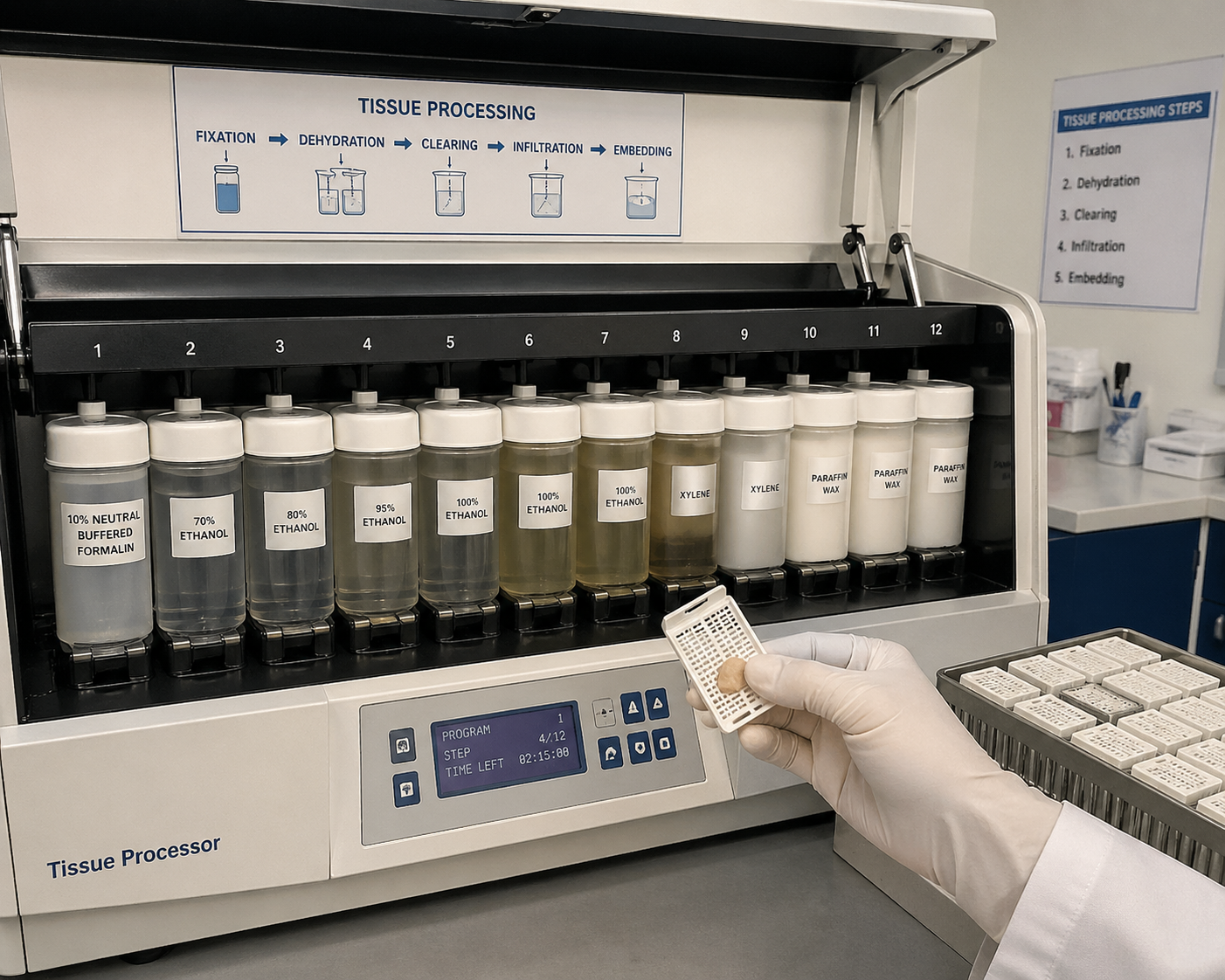
Tissue processing may be performed manually or with the help of automated
tissue processor. Routinely 12 containers containing different solutions are used
for processing in the following order
10% formalin – container no 1, 2
50% alcohol – container no 3
90% alcohol – container no 4 & 5
Absolute Alcohol – container no 6
Acetone – container no 7 & 8
Xylene – container no 9 & 10
Paraffin Wax – container no 11 & 12