
1. Bile Solubility Test:-
This test helps to differentiate S. pneumoniae from iridans streptococci.
v Principle:-
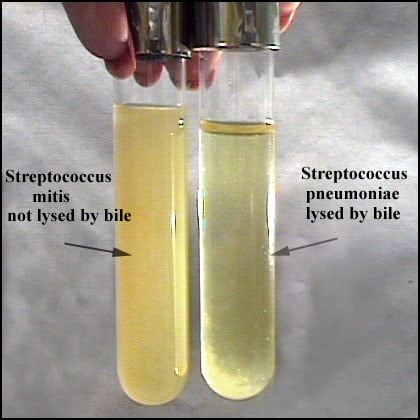
The test organisms are emulsified in normal saline. It gives a turbid suspension. The bile salt sodium deoxycholate is then added. S. pneumoniae organisms are soluble in bile salts and it is indicated by the clearing of turbidity. Viridans streptococci are insoluble in bile salts and it is indicated by persistence of the turbidity.
v Requirements:-
1. 10 g/dl sodium deoxycholate in 0.85 g/dl, sodium chloride.
2. Normal saline.
3. Test tubes (15 x 125 mm).
v Procedure:-
1. Pipette 2 ml of normal saline in a test tube.
2. Suspend several colonies in the saline.
3. Divide the suspension between two tubes.
4. To the tube labeled as ‘T’, add 2 drops of sodium deoxycholate reagent, and to the tube labeled as ‘C’ add 2 drops of sterile distilled water. Leave both the tubes for 10-15 minutes.
5. Observe the tubes.
v Observation:-
1. Clearing of turbidity: Probably S. pneumoniae.
2. No clearing of turbidity: The organism is probably not S. pneumoniae.
v Quality control:-
Use the following microorganisms
to confirm the reliability of reagents:
Positive control: Streptococcus pneumonia
Negative control: Enterococcus fecalis