


Centrifuges:-
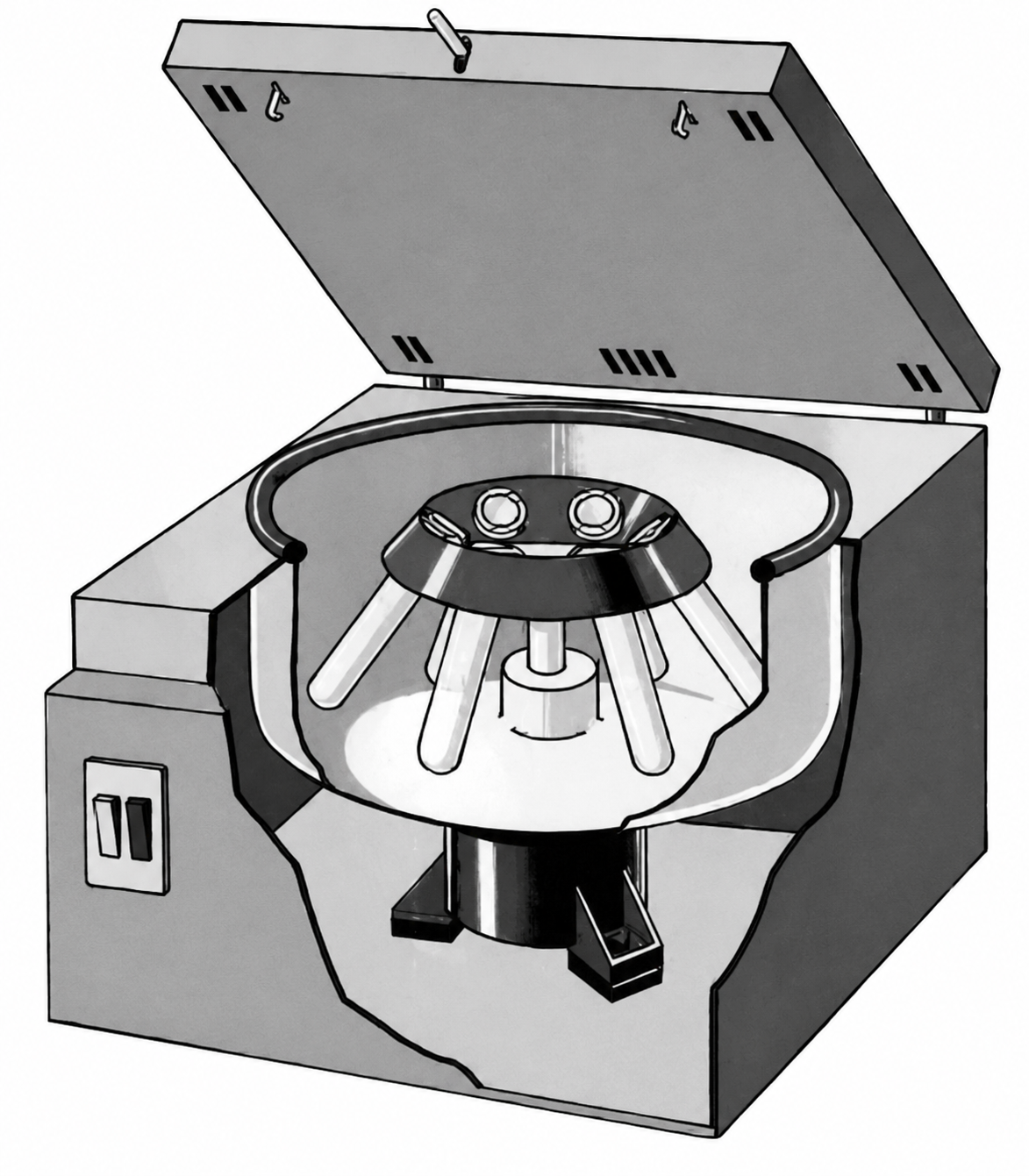
A centrifuge is a mechanical device that rotates a container at high speeds to separate a mixture into its component parts based on their density.centrifuge are designed to accelerate the sedimentaion process by using centrifugal force.
The two general types of centrifuges used uin the laboratories are:-
A. The swing out head type (horizontal rotor) B. The anglehead type(fixed angle rotor)
In the case of swing out head centrifuge the tubes are in a vertical position when the centrifuge is at rest and assume a horizontal position when the centrifuge is operating.The speed of centrifuge is more than 5000 RPM.
The angle head centrifuge tubes are positioned rigidly at a fixed angle (20-40 degree) to the vertical of rotaion. due to the very low friction of air, angle head rotor units can attain much higher speed.The centrifuge capable of producing speeds up to 100,000 RPM with relative centrifugal force (RCF). The centrifuge based on the principle of centrifugal force, which acts on a sunstance in circular motion, towards the periphery.
Principle:-
the factors which govern the speed of centrifugation are:-
1.The rotation per minutes.
2.length of radius: the radius is measured from the center rotation to the inside bottom of the tube.
3.Shape and size of the particles.
4.viscosity and specific gravity of the fluid under centrifugation.
5.Gracitational force acting on the particles.
Important component of a centrifuge:-
2.Motor:- Provides the power required to rotate the rotor.Controls the speed of rotation (RPM).
3.Centrifuge Tubes:– Containers that hold the samples being separated.Usually made of glass or plastic and designed to withstand high speeds.
4 speed control and the additinal parts:- Used to set and monitor operating parameters such as speed (RPM), time, and temperature.Modern centrifuges often have digital displays.
5.Timer:- Allows the user to set the duration of centrifugation. Automatically stops the centrifuge when the set time is reached.
6.Spindle:- Connects the motor to the rotor,Transfers rotational motion from the motor to the rotor.
Uses of centrifuge:-
The centrifuge is used in laboratory for various purpose such as:-
1.The separtaion of serum or plasma from blood.
2.Separation of sediment in urine.
3.Separation of protein free filtrate.
4.Washing of red blood cells by normal saline(cell suspension).
5. Separation of antigen boundfraction or antibody bound fraction from the free fraction in immonoassays.
6.Separates microorganisms such as bacteria, fungi, and viruses from liquid media.
7.Separates and purifies drugs, vaccines, and biological products during manufacturing in pharmaceutical industry.
8.Used in cell biology, biochemistry, genetics, and medical research for the separation of cellular organelles and other biological materials.
Procedure for useing centrifuge:-
1.Place the samples in appropriate centrifuge tubes.Ensure that the tubes are properly labeled.
2.Place tubes of equal volume and weight opposite each other in the rotor.An unbalanced centrifuge can cause vibration and damage.
3.Insert the tubes securely into the rotor slots or buckets.Check that all tubes are properly seated.
4.Close the centrifuge lid firmly.
5.Select the required RPM (speed),Set the desired centrifugation time.
6.Switch on the centrifuge and allow it to reach the set speed.
7.After the set time, the centrifuge will stop automatically.
8.Carefully open the lid,Remove the tubes gently without disturbing the separated layers.
9.Clean the rotor and chamber according to laboratory guidelines.
Care and Maintenence:-
1.Place the centrifuge on a firm base.it should not be placed near a sensitive equipment such as photometer or spectrophotometer, because it generates electrical noise and high current drain when stared up.It should not be run near the a combustible fluid.
2.Before the centrifugation,the centrifuge tubes and the cups or tubes of centrifuge should be balanced properly.
3.The chamber should be kept clean.All the splits should be clean immediately since it may contain biohazardous materials.(chemical,microbiological or radioactive)
4.Always make sure that the cover is closed while the centrifuge is operating .Never open the chamber until the rotor has come to a complete stop.
5. Observed for usual normal vibration noise during operation. The centrifuge may vibrate excessively,if the tubes inside are not balanced properly,should be check immediately.
6.Place a plastic cover on the centrifuge when nor use.