
SUMMARY:-
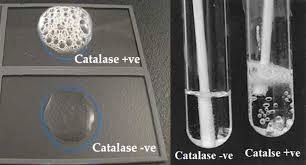
This test is used to differentiate catalase-producing bacteria such, as Staphylococci from non-catalase-producing bacteria such as Streptococci.
v Principle:-
Catalase produced by the organisms acts on hydrogen peroxide to produce water and oxygen (It is indicated by bubbles).
v Requirements:-
1. 3% (v/v) Hydrogen peroxide
2. Test tubes (15 x 125 mm)
v Procedure:-
1. Pour 2 to 3 ml of hydrogen peroxide solution into a test tube.
2. Immerse the growth of organisms in the test tube solution by using a
sterile wooden stick (or a sterile glass rod).
3. Look for immediate bubbling.
v Observations:-
1. Appearance of bubbles: Presence of catalase-producing organisms.
2. No formation of bubbles: Presence of non-catalase-producing organisms.
v Precautions:-
1. The culture should not be for more than 24 hours.
2. This test should be performed from a blood-free culture medium (nutrient agar) since catalase is also present in red blood cells
v Quality control:-
Use the following
microorganisms to confirm the reliability of reagents:
1. Positive control: Staphylococcus species
2. Negative control: Streptococcus species