
Light source:-
Light source can be external or inbuilt. Dispersal of heat, collection of greatest amout of light, direction and distance are carefully calculated by the designers of microscope for greatest efficiency
Condensers:-
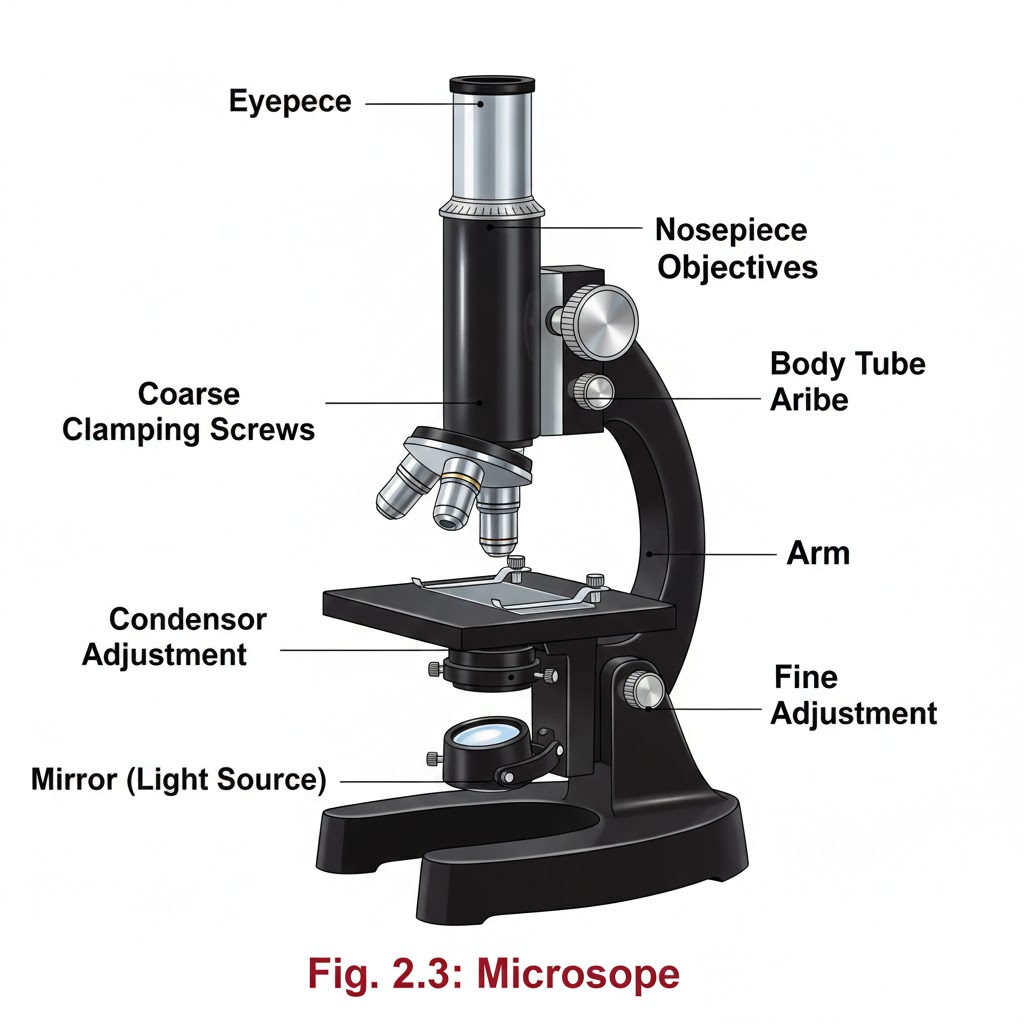
Body Tube Objectives Stage Clamping Screw Condenser Mirror (Light Source) Fig. 2.3: Microscope Condensor Adjustment The purpose of condenser is to concentrate the light into the plane of the object. The more the light at the specimen, better is its resolution. All condensers have aperture diaphragm with which the diameter of the light beam can be controlled
Object stage:-
It is a rigid platform with an aperture through which the light can pass. It supports the glass slide. It allows controlled movement in two directions.
Objectives:-
They are the most important parts of microscope. The main task of objective is to collect the maximum amount of light from the object, unite it and form a high quality magnified real image. Magnifying powers of objectives are from 1:1 to 100:1.
Body tube:-
Body tube can be monocular, binocular and the combine photo-binocular (also called trinocular). Binocular tubes have provision for inter-pupillary distance
adjustment, enabling each observer to adjust for his eyes
Eyepiece :-
The final stage in optical path, the eyepiece’s function is to magnify the image formed by the objective within the body tube, and present the eye with a virtual image.
Use of the Microscope :-
* Illumination should be centered.
*The condenser should be centered and in proper position.
*Objectives should be properly screwed.
*Optical parts should be clean and free from dust.
*Use oil only for oil immersion objective. After use, clean the oil objective with lens tissue. Avoid use of xylene, alcohol or acetone. Eyepieces get dirty by grease from eyelashes, clean them with lens paper.
*When changing slide, always lower the stage before removing the slide or change objective lens to scanner view.
*Make sure the slide is the right way up